
Some links below are affiliate links, that help keep this site running at no extra cost to you. Learn more here.
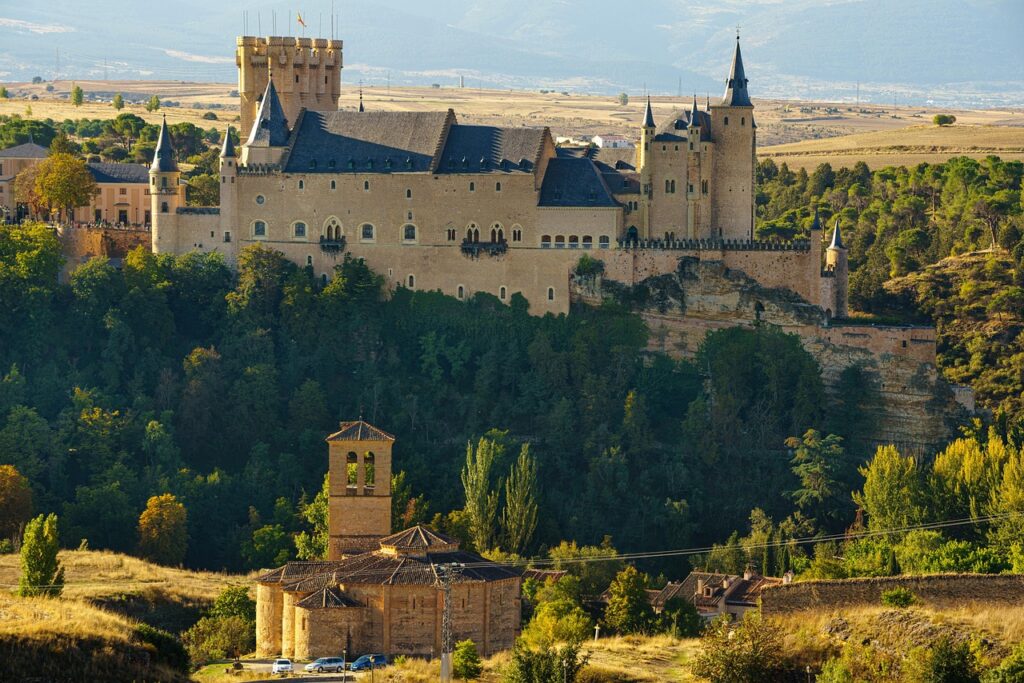
The Alcázar of Segovia is the reason most people come to Segovia in the first place. Imagine a fortress on a rocky spur above the meeting of the Eresma and Clamores rivers, with turrets that look like someone drew them for a fairy tale. It’s about an hour from Madrid, and you can see it properly in a morning.
This guide covers what tickets actually cost, the two ticket types you’ll be choosing between, the free-entry window most visitors don’t know about, and the practical details – how long you need, whether the tower is worth it, and when to turn up to avoid the crush.
Book a guided walking tour for the Alcázar de Segovia below, which also includes the Cathedral of Segovia access (Spanish speaking only):
Ticket prices
There are two tickets, not one ticket with add-ons. This trips people up at the counter.
| Ticket | Includes | General | Reduced |
|---|---|---|---|
| Palace + Museum | Royal chambers, courtyards, Artillery Museum | €6 | €4 |
| Palace + Museum + Tower of Juan II | All of the above plus the tower climb | €9 | €7 |
| Children under 5 | — | Free | — |
Reduced rates apply to under-16s, students, over-65s, large families, registered unemployed and visitors with a disability of 33% or more. Important: you generally can’t buy reduced tickets online, because staff need to see your ID. Buy those at the box office.
Prices are reviewed periodically — worth a quick check on the official site before you travel.
Free entry on Tuesdays (EU citizens)
EU citizens get free entry to the Palace + Museum on Tuesdays between 14:00 and 16:00. The conditions:
- It excludes national, regional and local public holidays
- You must buy individually at the box office during that window – it isn’t available online
- It’s subject to capacity, so it can be refused if the monument is full
- It covers Palace + Museum only. The Tower of Juan II is not included
If you’re travelling on a UK passport post-Brexit, this no longer applies to you. Irish, and other EU passport holders, still qualify.
Where to buy tickets
You can book through the official ticketing site: entradas.alcazardesegovia.com.
If you’re coming from Madrid without a car, a day trip that bundles transport and entry is usually better value than assembling it yourself.
Where is the Alcázar?
The Alcázar sits at the opposite end of the old town from the aqueduct, with Segovia Cathedral roughly in the middle. It about a 15-20 minutes uphill walk through the old town.
It’s all pedestrianised cobblestone streets. The route is well-signposted and takes you through lovely medieval streets with shops and cafés. Segovia Cathedral is roughly halfway between the two. If you don’t fancy the walk, local buses connect different parts of the city, but honestly, walking is the best way to see everything.
Ticket prices and opening hours
You can opt for individual tickets which are cheaper than booking a tour:
Opening hours:
- April to September: 10:00am to 8:00pm (daily)
- October to March: 10:00am to 6:00pm (daily)
The Alcázar is open every day except December 24, 25, 31, and January 1.
Ticket prices:
- General admission: €6
- Students, seniors (65+), children (5-16): €3
- Children under 5: Free
- Tower of Juan II: Additional €3 (separate ticket required)
- Audio guide: €3
You can buy tickets at the entrance, but I’d recommend booking online during peak season (summer months and holidays) to skip the queues. The ticket office accepts both cash and cards.
My top tip: If you’re planning to visit multiple monuments in Segovia, look into combined tickets that include the Alcázar, Segovia Cathedral, and other attractions. It works out cheaper than buying separately.
What you’ll see inside the Alcázar
The Royal Chambers
You’ll start your visit in the beautifully restored royal chambers. The Sala de la Galera (Galley Room) has an incredible ceiling decorated with 392 gilded pineapples – each one is unique. The walls are covered with a frieze showing the 52 kings and queens of Asturias, Castile, and León.
The Throne Room is absolutely stunning with its intricate Mudéjar-style ceiling and dramatic throne platform. The walls feature paintings of the Catholic Monarchs, Ferdinand and Isabella, who were proclaimed queen here in 1474. The detail in the woodwork is extraordinary – you could spend ages just staring at the ceiling.
The King’s Chamber and Queen’s Chamber both have ornate decorations and period furniture that give you a real sense of royal life. The Queen’s Chamber has particularly lovely stained glass windows that throw coloured light across the room.
The Chapel
The Alcázar’s chapel is small but beautifully preserved, with Gothic architecture and a stunning altarpiece. It’s still used occasionally for special ceremonies and weddings. The intimate space feels worlds away from the grand throne rooms.
The Weapons Room (Sala de Armas)
This hall houses an impressive collection of medieval weapons and armour. You’ll see everything from swords and lances to full suits of armour worn by knights. The displays explain how warfare evolved over the centuries, from heavy plate armour to more mobile designs.
Kids particularly love this room – there’s something about seeing actual weapons and armour that brings history to life. You can really imagine knights clanking around in those metal suits!
The Tower of Juan II
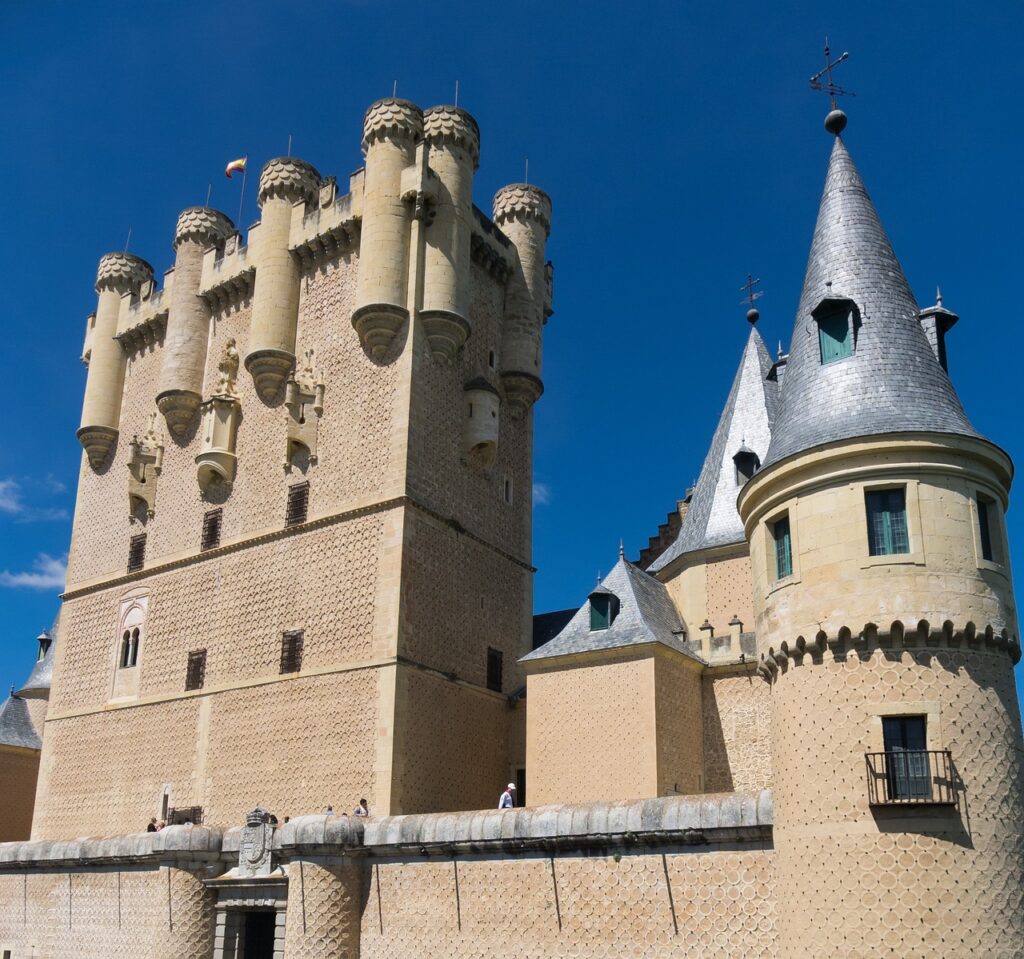
This requires a separate ticket (€3 extra) and climbing 156 steps up a narrow spiral staircase, but the views from the top are absolutely worth it. You’ll see panoramic views across Segovia’s old town with its terracotta roofs, Segovia Cathedral rising above the houses, the Roman aqueduct in the distance, and the plains stretching to the Guadarrama mountains.
The staircase is quite narrow and steep, so it’s not suitable for people with mobility issues or anyone who struggles with heights. There’s no lift option. The stairs wind up and up, getting narrower near the top, but push through – those views are incredible.
My top tip: Go up the tower near sunset if you’re visiting in summer when the Alcázar stays open late. The golden light across the city is magical, and you’ll get incredible photos. In winter when it closes at 6pm, aim for late afternoon instead.
The Alcázar’s connection to Disney
You’ve probably heard that the Alcázar of Segovia inspired Walt Disney’s design for Cinderella’s Castle (in some versions, Sleeping Beauty’s Castle). While Disney never explicitly confirmed this, the resemblance is striking – particularly those distinctive pointed turrets and the dramatic hilltop position.
Disney visited Europe in the 1920s, and many believe he saw the Alcázar during his travels. Whether it directly inspired his designs or not, the connection has made the castle even more popular with visitors, particularly families with children who recognize it from the films.
There’s a small exhibition inside about this connection, with comparisons between the castle and various Disney designs. Kids love spotting the similarities!
How long do you need?
The official estimate is 40 to 45 minutes for the Palace and Museum at your own pace. If you’re adding the tower, budget around an hour and a half total – and note that tower visits are capped at 25 minutes, so you can’t linger at the top.
Realistically, half a day covers the Alcázar plus the walk down through the old town to the cathedral and aqueduct.
Is the Tower of Juan II worth it?
Yes, if you can manage the stairs. It’s 152 steps up a narrow spiral staircase, 33 metres, with no lift. From the terrace you get the old town’s terracotta roofs, the cathedral, the aqueduct in the distance and the Guadarrama mountains beyond.
Who should skip it:
- Anyone with mobility issues, heart or breathing conditions, or a serious problem with heights
- Anyone in a hurry — the timed slots are strict
- Under-16s cannot climb the tower unaccompanied, and under-16s can’t visit the Alcázar unaccompanied at all
My top tip: in summer, aim for a late-afternoon tower slot. The light across the city is much better than at midday, and the crowd has thinned. In winter, with an 18:00 close, mid-afternoon is your window.
Best time to visit the Alcázar de Segovia
Early morning (10:00am-11:00am): Quietest time with fewer crowds and the best light for photos of the exterior. Tour groups usually arrive later in the morning.
Late afternoon (4:00pm onwards): Another good time to avoid the worst crowds. If you’re visiting in summer, this is when the afternoon heat is starting to fade too.
Avoid midday (12:00pm-3:00pm): This is when tour groups from Madrid arrive en masse, and the Alcázar gets packed. You’ll be queuing to get in and jostling for space inside the royal chambers.
Winter visits: Much quieter than summer, though the earlier closing time (6:00pm) means you won’t catch sunset from the tower. The castle looks beautiful with snow on the mountains behind it, and you’ll practically have the place to yourselves on weekdays.
Best months overall: May, June, September, and October offer the perfect combination of good weather and manageable crowds.
What’s the difference between the Alcázar and Segovia Cathedral?
They’re two completely separate monuments. The Alcázar is the royal castle/fortress at the western end of the old town. Segovia Cathedral is a Gothic cathedral roughly in the middle of the old town on Plaza Mayor. Both are worth visiting, but they’re different buildings with separate admission tickets.
Can you take photos inside the Alcázar?
Yes, photography is allowed inside without flash. The rooms are well-lit so you’ll get decent photos. The best exterior shots are from the viewpoint behind the castle – walk around the back for that classic fairy-tale angle with the turrets silhouetted against the sky.